


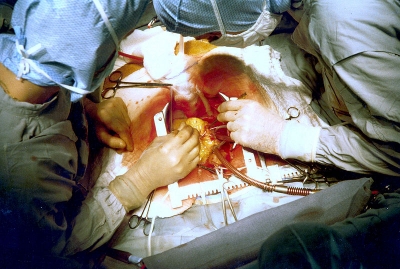
Outcomes for adult cardiac patients have improved dramatically over the past five years even as more elderly and high-risk patients are now being treated; these are the findings of a comprehensive new study of over 400,000 operations from the Society for Cardiothoracic Surgery of GB and Ireland (SCTS) just published. The results prompt the Royal College of Surgeons of England to urge all surgical specialties to follow the lead as soon as possible.
The report, entitled Demonstrating Quality: The Sixth National Adult Cardiac Surgical Database Report, conclusively proves wrong critics who suggested that publishing mortality data would lead to risk-averse behaviour from surgeons, with the most sick and elderly patients being turned down for surgery for fear of blotting statistics. In practice, the opposite has turned out to be true - the increase in reliable data has emboldened surgeons to take on more complicated cases. More people who would have been considered too sick to undergo an operation just five years ago are now routinely treated and doing well.
The database findings provide compelling evidence that, since national publication of mortality rates in cardiac surgery began in 2001, the quality of care for patients has improved. These include:
* Mortality rates for ‘coronary artery surgery' have fallen by 21 per cent and for ‘isolated valves' by a third. For elective surgery in the under-70s mortality rate for ‘coronary artery surgery' is now less than one per cent.
* The proportion of elderly patients being seen for surgery has increased. One in five ‘coronary artery bypass' patients were over 75 and five per cent over 80 years old. The average age of aortic valve replacement patients has increased from 61 in 1994 to 68 in 2008.
* More diabetic, high blood pressure and overweight or obese patients are having cardiac surgery, all known risk factors, yet overall operation mortality rates continue to fall.
* Between 2001 and 2008 there has been a 50 per cent increase in the proportion of coronary surgery patients who are diabetic.
* Between 2001 and 2008 the proportion of coronary patients with hypertension (high blood pressure) has increased from less than 60 per cent of cases to nearly 75 per cent.
* Redo operations (for bleeding or deep sternal wound infection) are rare and getting rarer. The re-do rate for bleeding fell from 3.8 to 3.2 per cent between 2004 and 2008 and for infection from 0.8 per cent to 0.6 per cent over the same period and the time between first and second operations is increasing, indicating that the grafts are lasting longer.
* More than twice as many people are now having ‘aortic valve replacement' and ‘mitral valve operation'. Both these procedures are more commonly required for more elderly patients and this increase reflects the increasing life expectancy for those with heart disease.
The full analysis - published jointly by the SCTS and Dendrite Clinical Systems Ltd - of so many operations gives a complete breakdown of how cardiac surgery is developing and highlights areas for future improvement including unequal access to cardiac surgery across the UK. For example, while mortality rates across the board are improving there remains a persistent gap between the sexes with survival rates significantly worse for women than for men.
With mortality rates for cardiac surgery so low - cardiac surgeons are now looking at extending outcome reporting to other areas which impact on recovery time and quality-of-life such as bleeding rates, post-operative stroke, kidney failure and the need to re-do operations.
Report author and University Hospital of South Manchester Consultant cardiac surgeon, Ben Bridgewater, said:
"One of the benefits we are now seeing from public reporting of outcomes is not just about bringing poor performers ‘into the pack' but improving the performance of the pack as a whole. The very act of auditing services brings about improvements as centres learn from one another."
Contact David Fewster - Worldwidehealth Editor
This form is intended for genuine enquiries only.