


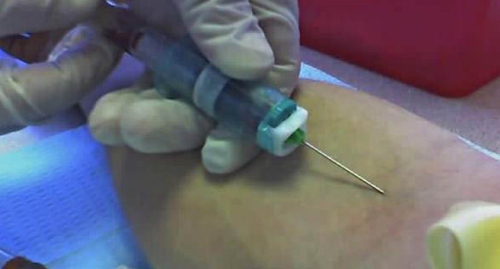
Blood tests have been extremely important tools aiding doctors in making medical diagnoses and in guiding the treatment of many diseases. However, psychiatry is one area of medicine where there are few diagnostic blood tests.
New scientific fields may someday generate blood tests that can be used for these purposes. Some of the areas under increasingly intensive study are genetics, the study of variations in the genes (DNA) that can be extracted from blood cells, and genomics like proteomics, the measurement of the levels of specific proteins in the blood, and gene expression profiling, which measures the levels of RNA produced from DNA as an indication of the level of the "activity" of particular genes.
Using the latter approach, Dutch researchers evaluated blood gene expression profiles in healthy individuals and patients diagnosed with major depressive disorder, or MDD. They identified a set of seven genes in whole blood that was able to distinguish un-medicated MDD patients from healthy controls.
"This is a first, but major step in providing a molecular diagnostic tool for depression," explained Dr. Sabine Spijker, corresponding author of this study. Although psychiatry already has specific criteria for diagnosing mental health disorders, this type of diagnosis would be unbiased and particularly valuable for those with whom it is more difficult to have a conversation. It may also eventually assist in reducing the stigma associated with mental health problems.
"It is far too early to be confident that gene expression profiling will lead us to diagnostic or prognostic tests for depression. However, the objective of this line of research is extremely important," cautions Dr. John Krystal, Editor of Biological Psychiatry. "In the past, many types of tests have been explored as potential diagnostic markers, but they all have failed to have sufficient sensitivity and specificity to guide doctors in making psychiatric diagnoses or choosing between treatments. I look forward to seeing whether the patterns of gene expression profiling are replicable and diagnostically specific as multiple groups report their findings."
Most importantly, the authors hope that this study is a stepping stone for finding markers that might predict treatment outcome and recurrence.
Contact David Fewster - Worldwidehealth Editor
This form is intended for genuine enquiries only.