


The premise that hunger makes food look more appealing is a widely held belief - just ask those who cruise grocery store aisles on an empty stomach, only to go home with a full basket and an empty wallet.
Prior research studies have suggested that the so-called hunger hormone ghrelin, which the body produces when it's hungry, might act on the brain to trigger this behavior. New research in mice by UT Southwestern Medical Center scientists suggest that ghrelin might also work in the brain to make some people keep eating "pleasurable" foods when they're already full.
"What we show is that there may be situations where we are driven to seek out and eat very rewarding foods, even if we're full, for no other reason than our brain tells us to," said Dr. Jeffrey Zigman, assistant professor of internal medicine and psychiatry at UT Southwestern and co-senior author of the study appearing online and in a future edition of Biological Psychiatry.
Scientists previously have linked increased levels of ghrelin to intensifying the rewarding or pleasurable feelings one gets from cocaine or alcohol. Dr. Zigman said his team speculated that ghrelin might also increase specific rewarding aspects of eating.
Rewards, he said, generally can be defined as things that make us feel better.
"They give us sensory pleasure, and they motivate us to work to obtain them," he said. "They also help us reorganize our memory so that we remember how to get them."
Dr. Mario Perello, postdoctoral researcher in internal medicine and lead author of the current study, said the idea was to determine "why someone who is stuffed from lunch still eats - and wants to eat - that high-calorie dessert."
For this study, the researchers conducted two standard behavioral tests. In the first, they evaluated whether mice that were fully sated preferred a room where they had previously found high-fat food over one that had only offered regular bland chow. They found that when mice in this situation were administered ghrelin, they strongly preferred the room that had been paired with the high-fat diet. Mice without ghrelin showed no preference.
"We think the ghrelin prompted the mice to pursue the high-fat chow because they remembered how much they enjoyed it," Dr. Perello said. "It didn't matter that the room was now empty; they still associated it with something pleasurable."
The researchers also found that blocking the action of ghrelin, which is normally secreted into the bloodstream upon fasting or caloric restriction, prevented the mice from spending as much time in the room they associated with the high-fat food.
For the second test, the team observed how long mice would continue to poke their noses into a hole in order to receive a pellet of high-fat food. "The animals that didn't receive ghrelin gave up much sooner than the ones that did receive ghrelin," Dr. Zigman said.
Humans and mice share the same type of brain-cell connections and hormones, as well as similar architectures in the so-called "pleasure centers" of the brain. In addition, the behavior of the mice in this study is consistent with pleasure- or reward-seeking behavior seen in other animal studies of addiction, Dr. Zigman said.
The next step, Dr. Perello said, is to determine which neural circuits in the brain regulate ghrelin's actions.
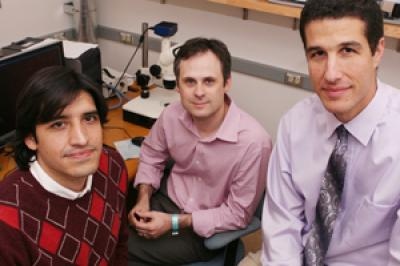
Photo: (from left) Dr's. Mario Perello, Michael Lutter, Jeffery Zigman and their colleagues at UT Southwestern Medical Center in Dallas
Contact David Fewster - Worldwidehealth Editor
This form is intended for genuine enquiries only.