


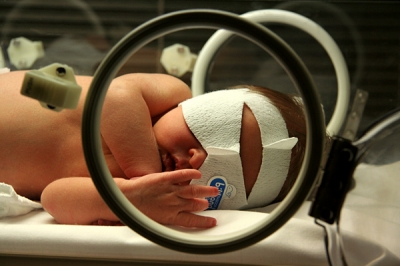
Screening all newborns for excessive bilirubin in the blood can significantly decrease the incidence of severe jaundice, which, in extreme cases, can lead to seizures and brain damage, according to researchers.
The study, one of the first to examine the effectiveness of universal screening for hyperbilirubinemia, appears in the current issue of "Paediatrics," the official journal of the American Academy of Paediatrics. The study is one of six in this issue to explore the topic of bilirubin and hyperbilirubinemia.
Hyperbilirubinemia is caused by an elevation of a bile pigment, called bilirubin, in the blood. Bilirubin is made when the body breaks down old red blood cells, and high levels can cause jaundice, a condition that makes the newborn's skin and the white part of the eyes look yellow.
The researchers explain that most newborns have a rise in bilirubin in the days following birth. However, very high blood levels can be toxic to the nervous system. Monitoring these levels in babies with jaundice is important so that treatment can be started before levels become excessive, explain the researchers. They add that high bilirubin levels can be treated with light therapy, which converts the bilirubin into a form that the body can remove.
"While we know that early identification of bilirubin levels before reaching toxic levels is important, bilirubin screening has not been universal, as physicians have decided which infants to screen based upon their degree of jaundice and clinical risk factors," said Michael Kuzniewicz, MD, MPH, the lead author of the study and a neonatologist at UCSF Children's Hospital. "This study provides evidence that universal screening during the birth hospitalization is a more effective method for monitoring bilirubin levels in order to prevent them from rising to a point that can damage an infant's brain."
The study evaluated the impact of implementation of the 2004 American Academy of Paediatrics (AAP) guideline on the management of jaundice in the Northern California facilities operated by Kaiser Permanente. The guideline recommends that every newborn be assessed for the risk of developing severe jaundice with a bilirubin level before discharge home and/or an assessment of clinical risk factors.
With universal screening, researchers noted a 62 percent decrease in the number of newborns with very high bilirubin levels. The study also describes an increase in the use of phototherapy to treat infants with elevated bilirubin levels, sometimes even when the AAP guidelines did not call for it.
Researchers in this study evaluated both blood tests and devices that estimate the bilirubin level from the colour of the baby's skin as methods of screening. "The method didn't seem to matter as much as changing the standard operating procedure, such that all babies are screened," said study co-author Gabriel Escobar, MD, regional director for hospital operations research and a research scientist with the Kaiser Permanente Division of Research's Perinatal Research Unit in Oakland, CA. "With additional education to help avoid excessive use of phototherapy, we think universal screening is a very good tool to reduce cases of serious hyperbilirubinemia."
"This research highlights the power of laboratory databases in supporting research and quality improvement," according to senior author Thomas B. Newman, MD, MPH, with the UCSF Department of Epidemiology and Biostatistics and the UCSF Division of General Paediatrics.
Contact David Fewster - Worldwidehealth Editor
This form is intended for genuine enquiries only.