


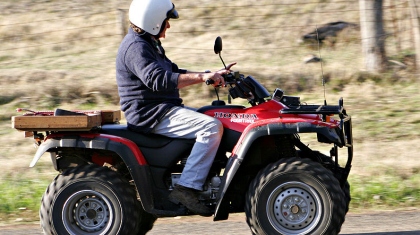
Over the years, all terrain vehicles (ATVs) and motocross motorcycles have gained popularity and marketed as toys to consumers. These high-velocity machines can weigh between 300 and 600 pounds, and run on average between 25 and 60 miles per hour, while some even reach maximum speeds of 75 miles per hour.
In 2008, nearly 28 percent of all ATV-related injuries were to children younger than 16. There were an estimated 135,000 injuries for riders of all ages for ATV use. A majority of ATV injuries happen from tipping, overturning or multiple riders.
Three new studies are the focus of a media briefing at the 2010 Annual Meeting of the American Academy of Orthopaedic Surgeons (AAOS). Kevin G. Shea, MD, orthopaedic surgeon specializing in paediatrics will moderate this panel and he, along with other study authors will release new information on ATV and motocross trends, and highlight ways to prevent severe orthopaedic trauma from these vehicles.
"I practice in Idaho, where ATV ridership is very common," explained Dr. Shea. "These vehicles can produce significant injuries in young riders, and we care for many in our community. Nationwide, there is even a rise in amputations and death from the use of these powerful vehicles."
Trends in ATV-related Spine Injuries in Children in the U.S. 1997-2006
Jeffrey R. Sawyer, MD, chief of paediatric orthopaedic trauma at Campbell Clinic-LeBonheur Medical Centre in Memphis looked at 4,483 children in the U.S. who were injured in an ATV-related accident over a period of several years. Of those children, 332 or 7.4 percent had a spine injury. This shows a 140 percent increase in children injured, and a 368 percent increase in the number of spinal injuries from 1997.
Of note:
76 percent of patients were male;
85 percent were Caucasian ;
Mean age of those ATV riders was 12.9 years of age; and
70 percent of all injuries were to children younger than 16 years of age.
Evaulation of MR-ATVs (Rhinos) vs. Single Rider ATVs: Primary Amputation and Open Fracture Incidence
Rhinos, or multi-rider ATVs are associated with great risk of primary limb amputation and significantly higher incidence of open extremity fractures compared to single-rider vehicles. Gregg Wendell Schellack, DO, a fifth-year orthopaedic resident at Loma Linda University in California, compared the injury differences between multi-rider ATVs and single-rider ATVs. A total of 110 patients were evaluated over a two-year period:
39 injuries were multi-rider related; while 71 were single-rider related.
64 percent of multi-rider related-injuries resulted in open fractures while 11 percent sustained open fractures on a single-rider ATV.
44 percent of mr-atv operators sustained severe, limb threatening open fractures while none of the sr-atv operators sustained an open fracture of this severity.
15 percent of multi-rider related injuries resulted in primary limb amputations while only 1 percent of single riders needed amputations.
The relative risk of amputation for MR ATV riders was 10.9 times higher than that of standard ATV riders.
Motocross Morbidity: Economic Cost and Injury Distribution in Children
A. Noelle Larson, MD, a Fellow in Paediatric Orthopaedics at Texas Scottish Rite Hospital, and co-authors at the Mayo Clinic found that paediatric motocross patients treated at a regional Level 1 trauma centre sustained severe injuries, frequently required admission and surgical intervention, even though they were wearing helmets and safety equipment.
Both recreational and competitive motocross activities were included. Over a seven-year period, 299 cases were noted in 249 patients, under the age of 17 years old:
the mean age of patient injured was 14.1 years;
94 percent of patients were male;
141 cases required hospital admission for a total of 412 inpatient days;
20 patients required intensive care unit admission; and
surgery was performed one-third of the time.
Dr. Shea added, "the increase in ATV-related injuries also places a greater demand on the health care system in terms of hospitalization time and charges. The current steps taken by the ATV and motorcycle vehicle industry are not enough. Actively engaging the riders, manufacturers and vehicle dealers will be critical, if we want to reduce injuries.
"Developing and enforcing a mandatory safety training session before these vehicles can be operated may be an important first step. Better education will be essential, as it is important to educate riders, parents and the public about the potential for serious injury," concluded Dr. Shea.
Contact David Fewster - Worldwidehealth Editor
This form is intended for genuine enquiries only.