


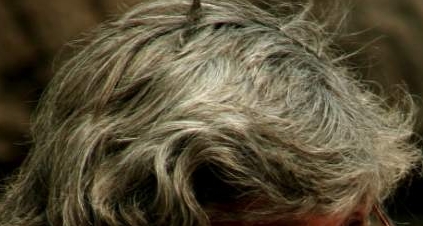
A team of European scientists from the Universities of Bradford, Mainz and Luebeck have finally solved a mystery that has perplexed humans throughout the ages: why we turn grey.
Despite the notion that grey hair is a sign of wisdom, these researchers show in a research report published online in The FASEB Journal that wisdom has nothing to do with it. Going grey is caused by a massive build up of hydrogen peroxide due to wear and tear of our hair follicles. The hydrogen peroxide ends up blocking the normal production of melanin, our hair's natural pigment. Melanin is the pigment responsible for hair colour, as well as skin colour, and eye colour.
The researchers made this discovery by examining native hair and cells isolated from human hair follicles. They found that the reduction in melanin production was the result of a complex series of events involving four different enzymes in the hair follicle cells.
Firstly, the build up of hydrogen peroxide in the hair was caused by a reduction in an enzyme (called catalase) that normally breaks up hydrogen peroxide into water and oxygen and gets rid of it. They also discovered that because of low levels of other enzymes (called repair enzymes A and B) the hair follicles could not repair the damage caused by the build up of hydrogen peroxide. Further complicating matters, the build up of hydrogen peroxide together with the low levels of the repair enzymes, disrupted the production of yet another enzyme (called tyrosinase). As tyrosinase is responsible for producing melanin the production of melanin in hair follicles was very much reduced.
The researchers speculate that a similar loss of melanin could be the root cause of vitiligo, a condition where white (de-pigmented) patches begin to appear on the skin.
Lead researcher, Karin Schallreuter, said: "This discovery is a major breakthrough in the understanding of hair greying and opens up some novel ideas to combat this scenario. These are being followed up at the current time in our laboratory."
Contact David Fewster - News Editor Worldwidehealth.com
This form is intended for genuine enquiries only.